

SMSF and Crypto: What Self-Managed Super Funds Need to Know in 2026
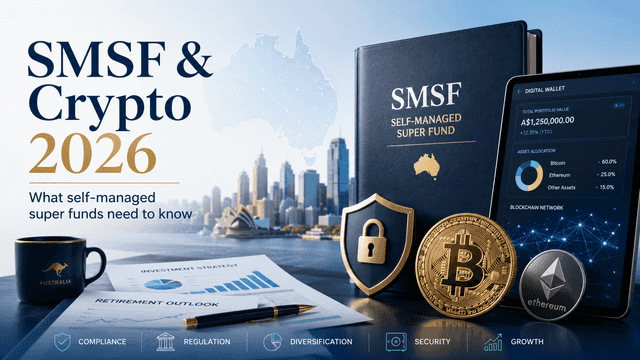
SMSF and Crypto: What Self-Managed Super Funds Need to Know in 2026
Learn how Australian SMSFs can invest in cryptocurrency in 2026 while meeting tax, audit, valuation, custody, security and compliance requirements. An SMSF may generally hold assets such as Bitcoin and Ethereum when the investment is permitted by its trust deed, supports its written investment strategy and satisfies the sole purpose test. Understanding how cryptocurrency and blockchain work and the role of self-custody crypto wallets can help trustees assess the ownership and security controls involved. Fund crypto must remain separate from personal holdings, with purchases, exchange accounts, wallet records and transaction evidence clearly connected to the SMSF. Australian trustees considering KuCoin should confirm that the account can be established in the fund’s correct legal capacity and retain complete records for annual tax reporting and audit purposes. Although KuCoin’s Australian subsidiary is registered with AUSTRAC as a digital currency exchange, trustees remain responsible for determining whether each investment is appropriate and compliant with Australian superannuation law.
What Is an SMSF and How Does Crypto Investing Work in 2026?
A self-managed super fund, or SMSF, is a private superannuation fund managed by its members, who also act as trustees and take responsibility for investment decisions, tax reporting, record-keeping and legal compliance. Unlike conventional retail or industry super funds, an SMSF gives trustees greater control over how retirement savings are invested, including potential exposure to cryptocurrency assets such as Bitcoin and Ethereum. However, SMSF crypto investing in Australia requires careful planning because the investment must be permitted by the fund’s trust deed, align with its documented investment strategy and satisfy superannuation, tax, valuation, custody and annual audit requirements. In 2026, trustees must also maintain clear proof of fund ownership, keep crypto separate from personal assets and manage risks involving volatility, cybersecurity, exchange failure and lost wallet access.
SMSF Crypto Tax, Compliance, Valuation and Audit Requirements
Holding crypto through an SMSF creates ongoing tax, reporting and audit obligations. Trustees must record transactions, prove fund ownership, calculate values in Australian dollars and maintain evidence for the annual independent audit.
How Is Cryptocurrency Taxed in an Australian SMSF?
Crypto held by an SMSF is generally treated as a CGT asset. Selling tokens, exchanging one crypto asset for another or transferring beneficial ownership may trigger a capital gains tax event. A complying SMSF is generally taxed at 15%, while eligible assets held for at least 12 months may receive a one-third CGT discount. Staking rewards and some airdrops may be ordinary income when received, with another tax event arising when the tokens are later sold. Trustees should understand what crypto staking means and how staking rewards work and record each reward’s date, quantity and Australian-dollar value.
SMSF Crypto Compliance and Record-Keeping Rules
Trustees should retain trade histories, exchange statements, wallet addresses, blockchain transaction IDs, fees and Australian-dollar values for every transaction. These records must also show that the crypto belongs to the SMSF and remains separate from personal assets.KuCoin users can export account and transaction history for tax and audit records,but these reports should still be reconciled with the fund’s bank statements and wallet records. Trustees should download and securely store data regularly rather than relying on an exchange to preserve it indefinitely.
Crypto Valuation and SMSF Audit Requirements at 30 June
An SMSF must report its crypto holdings at a supportable Australian-dollar market value as of 30 June, using an objective source such as a reliable exchange’s historical closing price. Trustees should retain token balances, the selected price source, valuation time and AUD conversion method, especially for illiquid assets where prices may be difficult to verify. The fund must also appoint an approved independent auditor each year, who may review KuCoin account reports, exchange statements, wallet records, blockchain transactions and trustee resolutions to confirm that the assets exist, belong to the SMSF and are correctly valued. A wallet screenshot alone may not prove ownership, so trustees should maintain complete audit evidence throughout the year.
How to Manage Crypto Custody, Security and Investment Risks in an SMSF
1. Keep SMSF Crypto Separate and Prove Fund Ownership: SMSF crypto must remain separate from trustees’ personal assets. Trustees should use dedicated bank, exchange and wallet accounts and retain KuCoin statements, transaction records, blockchain IDs and evidence confirming that the fund owns and controls the assets.
2. Strengthen Private-Key and KuCoin Account Security: Hardware wallets, private keys and recovery phrases should be protected through secure storage and restricted access. KuCoin users should enable two-factor authentication, a trading password, anti-phishing phrases and withdrawal-address controls. Multi-signature approval may also be suitable for larger holdings.
3. Assess KuCoin and Counterparty Risk: Trustees should review KuCoin Australia or another provider’s regulatory status, custody arrangements, cybersecurity, withdrawal controls and reporting tools. KuCoin’s Australian subsidiary is registered with AUSTRAC, but registration does not guarantee solvency, compensation or SMSF suitability.
4. Control Volatility, Concentration and Liquidity Risk: Trustees should set a documented crypto allocation and consider how major price declines could affect retirement goals, pension payments and cash reserves. Less-liquid tokens, staking arrangements and lending protocols may also restrict access to funds when money is required.
5. Plan for Lost Access and Trustee Incapacity: The SMSF should have a secure recovery and succession plan explaining who can access its wallets and exchange accounts if a trustee dies, loses capacity or leaves the fund. It should also cover lost keys, compromised accounts, provider contact procedures and the preservation of ownership records for tax and audit purposes.
What Has Changed for SMSF Crypto Investors in 2026?
The 2025–26 SMSF annual return requires trustees to report the market value of fund-owned crypto assets as at 30 June 2026. The reported amount should be supported by exchange statements, wallet balances, transaction records and reliable historical pricing. KuCoin users should download balance, trade, deposit and withdrawal reports early enough to reconcile the fund’s activity before preparing its financial statements, annual return and independent audit.
Conclusion
An SMSF can invest in cryptocurrency in Australia in 2026, but trustees must ensure that every investment is permitted by the trust deed, supports the fund’s retirement strategy and remains separate from personal assets. Accurate transaction records, clear proof of ownership and reliable 30 June valuations are essential for tax reporting and the annual audit. KuCoin Australia may provide access to supported crypto assets, local fiat services, account-security features and downloadable transaction reports, but using an exchange does not automatically make an investment SMSF-compliant. Trustees remain responsible for all investment, tax, custody, valuation and compliance decisions, so professional advice may be appropriate before using complex crypto products or allocating a substantial portion of retirement savings to digital assets.
Frequently Asked Questions About SMSF and Crypto in 2026
1. Can an SMSF invest in a Bitcoin or crypto ETF?
Yes. An SMSF may invest in a listed crypto ETF when the investment is permitted by its trust deed and consistent with its investment strategy. An ETF provides indirect crypto exposure without requiring the SMSF to manage private keys, although trustees must still consider fees, liquidity, issuer risk and tax consequences.
2. Can an SMSF buy cryptocurrency through KuCoin Australia?
An SMSF may potentially use KuCoin Australia, but trustees should first confirm that the account can be established and verified in the fund’s correct legal capacity. They must keep the fund’s transactions separate from personal activity and retain complete account, bank, wallet and valuation records for tax and audit purposes.
3. Are stablecoins treated as cash in an SMSF?
No. Stablecoins are crypto assets rather than ordinary cash deposits, even when they aim to maintain a value of A$1 or US$1. They can lose their peg, face issuer or reserve risks and create a CGT event when sold or exchanged.
4. Can an SMSF invest in NFTs or tokenised assets?
Potentially, but the treatment depends on the rights attached to the token. NFTs may be subject to SMSF collectables rules, while tokenised property or securities may raise separate ownership, valuation, licensing and compliance issues. The investment must also be permitted by the trust deed and support the fund’s retirement purpose.
5. Can an SMSF claim a deduction for crypto investment losses?
A capital loss from disposing of crypto generally cannot be deducted from staking rewards, contributions or other ordinary income. It is normally applied against capital gains, with any unused loss carried forward for possible use in future financial years.
6. Can an SMSF pay its minimum pension in cryptocurrency?
Generally, an in-specie crypto transfer should not be used to meet the minimum annual pension requirement. An SMSF with substantial crypto holdings should maintain enough accessible cash to pay pensions, tax, audit fees and other fund expenses.
7. What happens to SMSF crypto when a member dies?
The cryptocurrency remains an SMSF asset and does not automatically pass directly to the member’s family. The trustees must administer the death benefit according to superannuation law, the trust deed and any valid nomination, making secure wallet-access and succession planning essential.
Disclaimer: This article is for general information only and does not constitute financial, legal, tax or superannuation advice. SMSF trustees should seek professional advice based on their fund’s circumstances before investing in cryptocurrency.