Introduction for Funding Rate and Funding Fee
Funding rate is a unique feature of the perpetual contract market, serving as a mechanism to minimize the price gap between perpetual contracts and the corresponding spot market. Its calculation is related to the position value and impacts the position PNL and even the liquidation price. Further explanations are provided below.
1. What is Funding Fee?
The latest market price refers to the most recent matched fill price on the Echuca Trading Futures platform. To prevent this price from deviating too far from the spot market price, Echuca Trading Futures uses a funding fee mechanism to anchor the latest market price to the spot price.
2.Funding Fee Settlement Mechanism
Unlike delivery contracts, perpetual contracts do not require delivery. Users do not need to settle or clear them upon expiration and can hold them for an extended period. However, without settlement, a mechanism is needed to align the contract price with the spot price. This is what we refer to as the "funding fee mechanism". Simply put, perpetual contracts use this mechanism to peg contract prices to spot prices.
Funding fees are paid between long and short positions. The positive or negative funding rate determines whether the long or short position pays the fee.The fee is settled entirely among users, with no charges from the platform.When the funding fee is positive, long positions (those betting on a price increase) will pay the funding fee, while short positions (those betting on a price decrease) will receive the funding fee. The reverse applies when the funding rate is negative.
Note:
- The exact times at which funding fee payments are collected may vary by up to 20 seconds.
- The frequency (funding interval) at which funding fees are exchanged may be adjusted during cases of extreme market volatility. Always check official announcements for updates.
3.Calculation of Funding Rate and Funding Fee
3.1 Calculation of funding rate
The funding rate is calculated by using the median price in the order book and the index price:
Funding Rate = Clamp(Moving Average [{(Highest Bid Price + Lowest Ask Price) / 2 - Spot Index Price} / Spot Index Price - Interest], a, b) . The current USDT-margined daily interest rate is 0.06%, while the coin-margined daily interest rate is 0.03%.
Moving average is calculated using the total data points of the current funding interval. As data is calculated once every minute, each full funding interval includes a total of 8 * 60 = 480 data points. Values calculated within the current funding interval are taken as estimated funding rates. The value calculated at the end of the current funding interval, however, is used as the actual funding rate for funding fee settlements.
The specific parameters for a and b depend on the margin rate and may be adjusted by the official platforms in extreme market conditions:
Funding Rate Cap = (Minimum Initial Margin - Minimum Maintenance Margin) * 0.75
Funding Rate Floor = (Minimum Initial Margin - Minimum Maintenance Margin) * -0.75
For example, with an initial margin of 1% and maintenance margin of 0.5%, the maximum funding rate is: (1%-0.5%) * 75% = 0.375%. If the calculated rate F' 0.375%, the final funding rate F = 0.375%.
3.2 Calculation of funding fee
Funding Fee = Position Value * Funding Rate
The Position Value is determined by the mark price at the time of funding rate settlement.
✅Example:
For BTC/USDT perpetual contract, User A holds a 0.01 BTC long position, with the marked price at $5,000 and the funding rate at 0.01% at the time of funding rate settlement. Then:
Position Value = 0.01 * 5,000 = 50 USDT
Funding Fee = 50 * 0.01% = 0.005 USDT
When the funding rate is positive, long positions pay short positions. User A will pay a funding fee of 0.0005 USDT, while User B, holding an equal amount in a short position, will receive a funding fee of 0.0005 USDT.
Note: In inverse contracts, Position Value = 1 / Mark Price x Quantity.
4.Impact of Funding Fee Settlement on Position PNL and Liquidation
4.1 Impact on futures position
4.1.1 Impact on position PNL
At funding fee settlement, two scenarios may occur:
User A pays the funding fee, resulting in a position loss;
User B receives the funding fee, leading to a position profit.
This means that the settlement of funding fees directly affects position PNL. When a user needs to pay funding fees, their position will experience a loss.
4.1.2 Impact on liquidation
As mentioned, paying the funding fee can result in position loss and reduced position margin.When the margin falls below the maintenance margin, liquidation is triggered. Therefore, while funding fee settlement does not directly cause liquidation, it impacts position margin.
Please note that continuous payment of funding fees may result in the margin of your position falling below the maintenance margin, leading to forced liquidation.
5. How to Control Position Risk
The settlement of funding fees is linked to the position value and is positively correlated. The larger the position value, the more funding fee paid or received. If you hold a large position, it's advisable to pay more attention to the impact of funding fee settlements on your position.
5.1 Avoid the funding fee settlement times and try to close positions early.
Funding payments with a settlement frequency of every eight hours start at 00:00 (UTC), 08:00 (UTC), and 16:00 (UTC). Funding payments with a settlement frequency of every four hours start at 00:00 (UTC), 04:00 (UTC), 08:00 (UTC), 12:00 (UTC), 16:00 (UTC), and 20:00 (UTC). The exact times at which funding fee payments are collected may vary by up to 20 seconds. Only users holding a position at the time of settlement need to pay or receive funding fees. If the position is closed before settlement, there is no need to pay or collect funding fees.
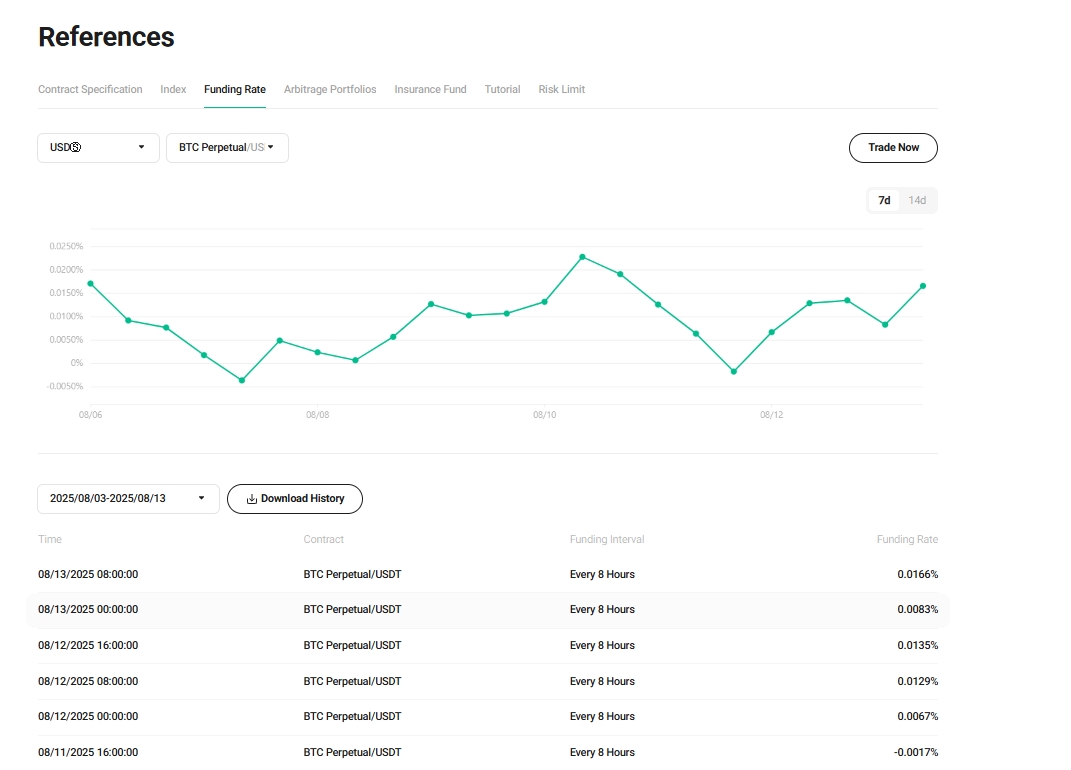
Echuca Trading supports viewing the funding rate history for each contract. For details, please click here.
5.2 It is advised to avoid placing orders with high leverage.
Beginners are recommended to use leverage of up to 5x to keep position risk within a reasonable range.
5.3 How to use the funding fee mechanism for stable arbitrage?
In addition to paying funding fees, it's also possible to receive them. So, how to continuously receive funding fees for stable arbitrage? The answer is the Funding Rate Arbitrage strategy, which can be used to obtain low-risk and long-term returns. This also allows for diversifying investments and hedging, enabling profits even in low-volatility markets.
In other words, you can implement funding rate arbitrage by simultaneously opening short positions in Perpetual Contracts and long positions in Spot Trading/Margin Trading/Delivery Contracts across different trading markets. Common arbitrage strategies include combining Perpetual Contracts with Spot Trading/Margin Trading, or combining Perpetual Contracts with Delivery Contracts. Further details on specific arbitrage operations will be covered in subsequent articles.
When considering strategies like basic arbitrage between perpetual contracts and spot markets or the multi-platform contract approaches, leveraging the dual advantages of funding rates is key. Each trading strategy carries its risks, so it's vital to choose a strategy that aligns with your preferences, establish your own investment rules, and control risks effectively.
Echuca Trading Futures Trading Guide: